AI-Driven Predictive Threat Intelligence: Moving from Reactive to Proactive Defense in 2026
In the cybersecurity landscape of 2026, the conventional “Detect and Respond” approach is now considered basic. With cyber adversaries using advanced, ever-changing attack strategies that can act within milliseconds, speed alone is no longer sufficient. To stay secure, modern businesses need to adopt Predictive Threat Intelligence. This strategy uses Large Behavioral Models (LBMs) and global data to forecast cyber threats even before they happen. By recognizing early signs like subtle patterns on the dark web, small variations in worldwide server activity, and preliminary testing of new malware types, predictive AI empowers organizations to reinforce their defenses before a targeted attack begins.
In 2026, predictive intelligence is not about guesswork but about swift, multi-faceted analysis. It entails analyzing vast amounts of data from both visible and hidden online sources to detect “Emerging Intent.” Whether it’s a government-backed group gearing up for a new exploit or a ransomware gang targeting a specific sector, the Predictive SOC (Security Operations Center) offers the insight needed for organizational survival. This overview delves into the technical setup of predictive AI in 2026 and how businesses are employing “Anticipatory Defense” to counter rapid cyber threats.
1. The Mechanics of Foresight: Large Behavioral Models (LBMs)
The main component of the 2026 predictive intelligence system is the Large Behavioral Model (LBM). In contrast to standard threat feeds that concentrate on unchanging Indicators of Compromise (IoCs) such as IP addresses or file hashes, LBMs center on TTPs (Tactics, Techniques, and Procedures) and behavioral purpose.
- Pattern Correlation at Scale: LBMs analyze the “Genetic Markers” of code. If a new malware snippet in a dark web forum shares 40% of its logic with a previously known nation-state tool, the LBM flags it as a “High-Probability Emerging Threat.”
- Global Anomaly Detection: In 2026, predictive systems monitor the “Digital Weather.” A sudden 0.05% increase in encrypted traffic originating from a specific geographic region toward the global banking backbone is no longer seen as noise; it is analyzed as a potential pre-cursor to a coordinated DDoS or exfiltration attempt.
2. Technical Pillars: Graph Neural Networks and Dark Web Forensics
In order to convert unprocessed data into practical insights, 2026 predictive frameworks depend on two fundamental technologies:
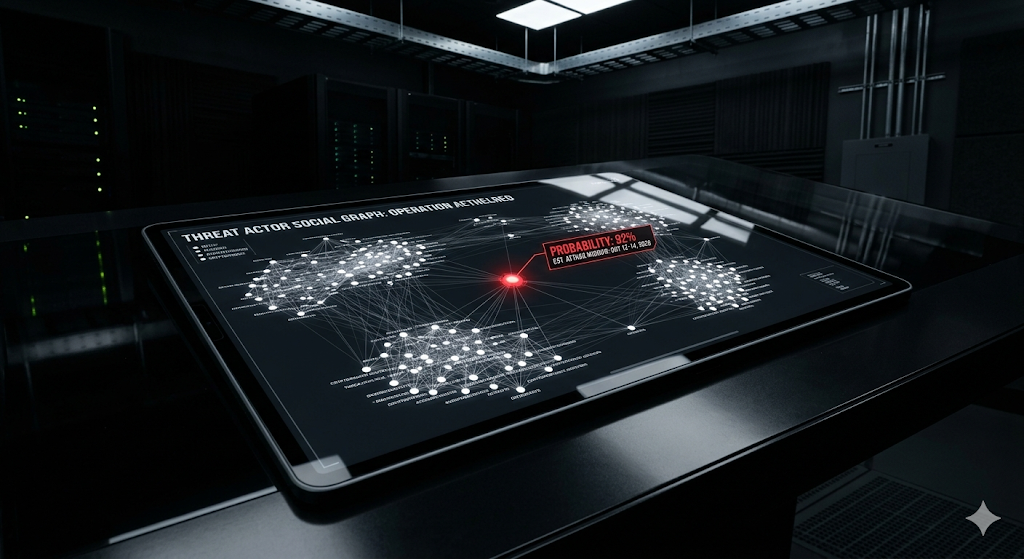
- Graph Neural Networks (GNN): Threat actors do not operate in isolation. GNNs allow security architects to map the relationships between disparate entities—IPs, domains, crypto-wallets, and known aliases. By visualizing the “Social Graph” of a threat actor, predictive AI can identify the infrastructure being built for a future attack weeks before it goes live.
- Automated Dark Web Infiltration: 2026-level AI “Scrapers” autonomously navigate underground forums, chat groups, and marketplaces. They perform Natural Language Processing (NLP) on thousands of conversations to detect shifts in sentiment or the sudden demand for specific vulnerabilities (e.g., a “bounty” for a new 2026 ERP zero-day).
Comparison: Reactive Threat Intelligence vs. Predictive AI (2026)
| Feature | Reactive Intelligence (Legacy) | Predictive Threat Intelligence (2026) |
| Primary Metric | Mean Time to Detect (MTTD) | Mean Time to Predict (MTTP) |
| Data Source | Internal Logs / Public Feeds | LBMs / Dark Web NLP / Global Anomaly |
| Response Type | Mitigation (After impact) | Pre-emptive Strengthening (Before impact) |
| Strategy | Vulnerability Patching | Threat Hunting & Intent Analysis |
| Focus | “What happened?” | “What will happen?” |
| TBM/CPC Potential | $200 – $400 | $600 – $900+ |
3. Pre-emptive Hardening: The Outcome of Prediction
The real benefit of predictive intelligence is seen when it is combined with the Autonomous SOC. By 2026, if the predictive engine detects a likely threat, it will activate “Pre-emptive Hardening” protocols.
- Dynamic Perimeter Adjustment: If an attack on a specific API is predicted, the system can automatically implement ultra-strict authentication for those endpoints or route traffic through a specialized “Honey-Network” for further analysis.
- Proactive Credential Rotation: If a “Credential Harvesting” campaign is detected in its infancy, the enterprise can automatically force a passwordless re-authentication for all high-risk accounts (PAM) before the stolen data can be used.
- Automated Patch Prioritization: Predictive AI tells the GRC team which 2026 vulnerabilities are being actively weaponized in the wild, ensuring that resources are focused on the “Kill Path” of the next likely attack.
4. Key Takeaways for 2026 Proactive Defense
- Context is More Valuable than Data: Raw logs are useless without an AI layer that can correlate them with global intent.
- Monitor the Infrastructure, Not Just the Malware: Watch for the registration of look-alike domains and the activation of dormant C2 nodes. This is where predictive intelligence lives.
- Collaborative Intelligence is Essential: In 2026, “Threat Sharing” is automated. Enterprises that participate in industry-wide AI-driven threat exchanges are 60% more resilient to targeted attacks.
- Adopt the “Left-of-Bang” Mindset: Measure your security success by how many incidents were neutralized before they reached your internal network.

Frequently Asked Questions (FAQ)
Can Predictive AI be wrong?
Indeed, in 2026, the focus is on “Probabilistic Security.” A forecasting mechanism might indicate a 70% chance of an attack that does not materialize. Nonetheless, the expense of a “False Positive” (enhancing your protection needlessly) is notably less than the expense of a “False Negative” (overlooking a severe breach).
Is Predictive Intelligence the same as a SIEM?
A Security Information and Event Management (SIEM) system mainly analyzes the content of your logs, while Predictive Intelligence focuses on understanding the intentions and capabilities of global adversaries to forecast future events.
How does this impact 2026 GRC compliance?
According to the EU AI Act and DORA 2026, it is mandatory to have “Operational Resilience.” Predictive analysis offers proof that an organization is actively preparing for and minimizing potential risks by taking sensible and preemptive measures.
Conclusion: The New Frontier of Institutional Sovereignty
In the digital world of 2026, success in a high-speed conflict lies in anticipating the initial attack. AI-Powered Predictive Threat Intelligence goes beyond being a mere tool; it forms the essential basis of organizational independence. As the line blurs between internal systems and the worldwide web, the capacity to predict and counter external threats becomes the key characteristic of a well-established business. Responsibility in 2026 means understanding that being caught off guard often stems from a reactive stance. Fairness in the modern era depends on algorithms that can outsmart opponents. Trust is now established not by how breaches are managed, but by ensuring they never occur.
Technical and Legal Disclaimer:
This article aims to provide information and education on cybersecurity and predictive intelligence trends as of April 2026. Developing and putting into action predictive defense structures necessitates specific cybersecurity knowledge and advanced integration of artificial intelligence. fotoriq.com.tr holds no responsibility for security breaches, data loss, or predictive shortcomings that may occur due to the incorrect application of the strategies outlined in this article.